How I Passed the CFA Level I Exam (Probably Around 90th percentile) While Studying Industrial Engineering Full-Time
I decided to study for the CFA Institute Level I exam in my first year of college because I’ve always wanted to work in finance, especially in asset/portfolio management. I decided to take the exam in the summer (2026 August Exam) between my 2nd and 3rd year, believing I’d get a full one and half months of free time after my university exams before the CFA exam. My application for the scholarship was rejected, which was a quite disappointing start.
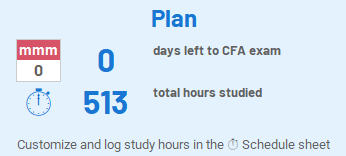
Although my academic background was in industrial engineering, not finance directly, I had already spent time outside of school reading books and spending time understanding investment related topics, as well as earning certificates like the FMVA, which is more practical and implementation-oriented than the CFA. But still, I knew that I had to work harder than the average candidate. That’s why I aimed to commit around 500 hours of study time. My plan was to begin in Febuary 2025 and aimed to sit the exam in August. However, due to a health problem and a surgery I had, I postponed my studies to one months later. During the winter semester, I also had 10 courses from my University in addition to 10 topics of CFA. With good time management, I managed to study more than 250 hours in 3.5 months of studying both for CFA and University courses which is also not easy and made me feel overwhelmed. At those times where I had to study for both University exams and CFA exam I used calendar very effectively and I even put lots of different alarms on my phone to schedule my in day activities. I think that studying CFA while studying undergraduate degree is harder than a full time job because of you never have a certain schedule of classes and also there are many extra tasks/projects you need to do beside university classes to pass.
To keep myself accountable, I used an Excel sheet from “300 hours” where I tracked topic readings, revisions, actual study hours and mock-exam results. Seeing the progress through that file kept me more motivated gradually, especially hard times when I needed to study for University and had to postpone my cfa studies for a while.
My Strategy
I developed a different study style compared to other CFA candidates. While other candidates go through the curriculum and take notes very rarely, In my first reading I studied in depth. I read every topic thoroughly and summarised everything in my own notebooks. In the end I had five large notebooks totalling around 400 pages. My first reading took around 320 hours, which is an amount of time that an average CFA student studies total. But this study method made me learn the concepts during my first read rather than relying purely on repetition. At the time, I thought I was going too slow, and it made me stressed.
However, because of that deep first read, my second pass was much faster. I already understood the core concepts, so instead of reading third-party books, I reviewed my own notebooks and my own words. That allowed me to complete the second read in around 100 hours. Most people approach the material by reading the books several times and doing questions along the way. I went: read & summarise → question bank + end-of-chapter Schweser questions → second read from my own notes with extra questions from the Learning Ecosystem.
This method required patience, but it allowed me to walk into the exam already confident in the underlying logic behind topics instead of relying on memorization.
Then, for the last month before my exam, I began mock exams. Many candidates start mocks while they are still in their first or second read. I waited until after my second read so that I could begin mocks in a strong position. My first mock came back at 84% correct answers. When I solved my first mock exam I saw the questions had a different structure than end of chapter questions or questions from Kaplan’s textbooks. For that reason I realised: I didn’t need a full third read. The incorrect answers were from very detailed, deep topics, not basics I was missing. So I kept doing mock → review every single question (even the ones I got right) and wrote down 40-50 sentences/pieces of information from each mock. It took a lot of time, after a mock I’d spend the next two days reviewing answers, then reading my notes (or revisiting Ethics) if needed.
For Ethics, I studied differently. I’m a more “reading learner” — so I read the Schweser books for most of the curriculum, but for Ethics I read only the CFA Institute’s Curriculum and the Standards of Practice Handbook.
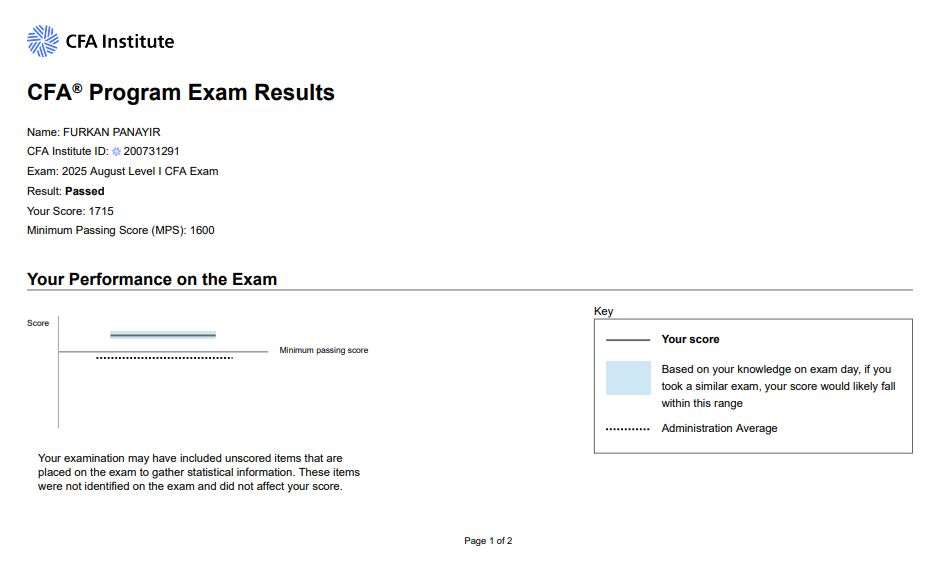
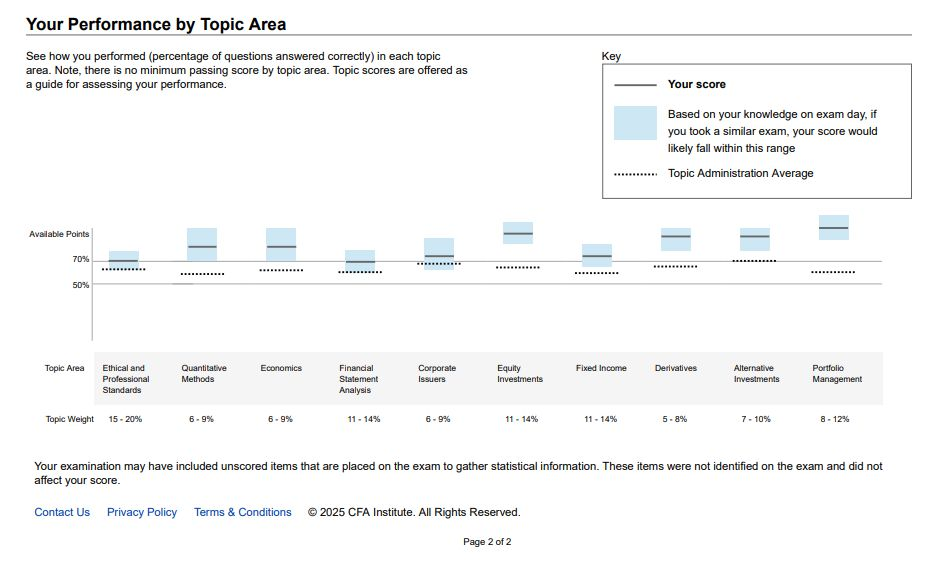
And a final note about 90th percentile: when I passed I saw that the CFA Institute had removed the official “90th percentile” indication, which was a little disappointing. Later on I saw on reddit that there was a white area in the CFA’s mail that you can copy to see a hidden message which says if you are in the 90th percentile or not. I do not know if it is a reliable source but it was written that I am in 90th percentile in my mail’s hidden section. Even though it does not mean anything since the real matter is to be fail or pass, I would like to see officially if I am in 90th percentile since I am still and undergraduate student who is willing to see where I am standing among all other participants of cfa level 1 exam which I know most of them are consisted of either investment professionals or finance graduates.
Looking back, it was not speed or natural ability that helped me. It was time planning, consistency, and staying calm when the process felt slow. If someone is studying for the CFA Level 1 while in a full-time study degree, I believe it is not too hard when you are determined, the main thing is effective time planning.
Resources I Used
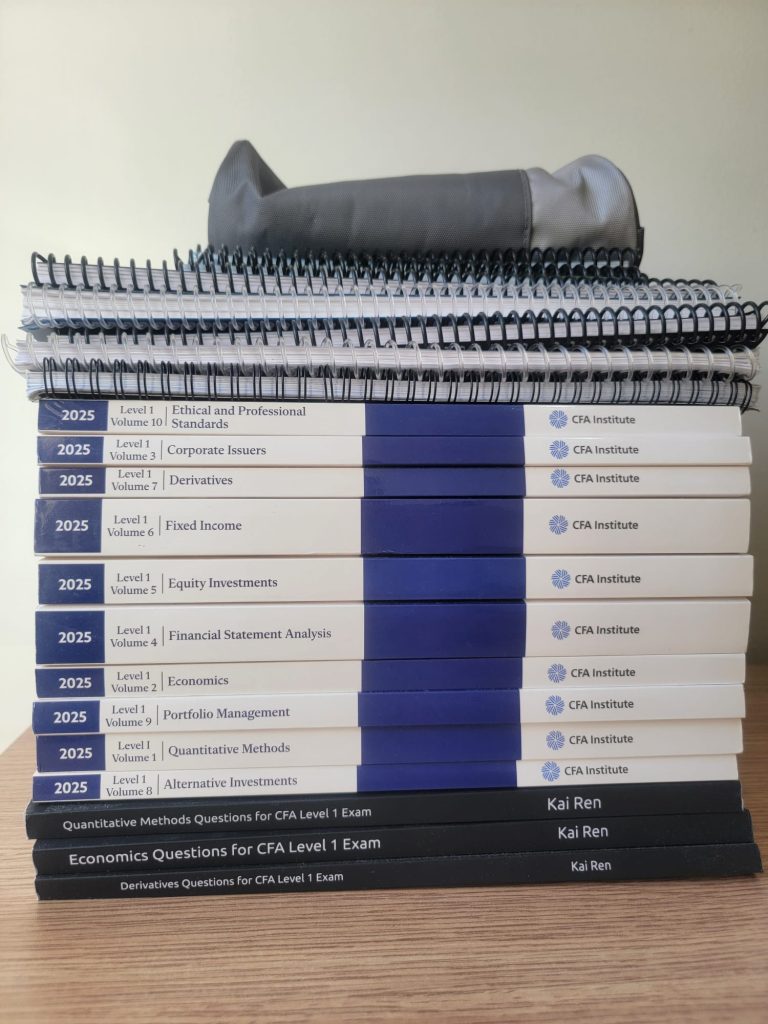
I am someone who learns best by reading and rewriting in my own words, so my resource selection reflects that:
- Schweser Notes
I used Schweser as my primary reading material for almost every topic. The structure helped me move through concepts without getting lost in excessive detail. - CFA Institute Curriculum
I primarily used it for:- Ethics cirriculum book
- Practice questions (I solved all eoc questions and some extra questions)
- Certain detailed Accounting (FRA) explanations
- Standards of Practice Handbook
For Ethics, this book is essential. I read it carefully, highlighted repeatedly, and referred back during review. - Schweser QBank + End-of-Chapter Questions
I treated these as reinforcement during my first and after my second read. - Mock Exams (CFA Institute Mocks Only)
The CFA Institute mock exams are especially valuable because they match the real exam structure and phrasing style. I also wanted to buy schweser ones because heard they are harder but just continued with CFAI mock exams.
Biggest Challenges
- Balancing Engineering Coursework + CFA Prep
Some days I studied Machie Technology and Electronics engineering during the day and then Equity Valuation at night. Switching mental frameworks was tiring. Also we had quizes each week for labaratory classes which made this journey even harder. - Staying Motivated During the Long First Read
Writing five notebooks’ worth of notes felt extremely slow. It required patience and trust in the process. However after I finished my first read it made me grasp almost all concepts within the curriculum - Not Comparing Myself to Others
CFA forums are full of people finishing the curriculum in 2–3 months. I had to remind myself that their speed wasn’t my speed and my method was working for me. At the end I ended up studying around 6 months but most importantly I feel like I had understanding on each topic and not just passed the exam.
